Changelly exchange is an instant swap route for 1000+ crypto assets
In short: Instant cryptocurrency swap service for trading Bitcoin and altcoins, with 1000+ assets available for wallet-to-wallet swaps.
Changelly exchange is an instant cryptocurrency swap service that routes Bitcoin and altcoin trades across partner liquidity venues, then sends the purchased asset to the wallet address. It supports wallet-to-wallet swaps for BTC, ETH, XRP, ADA, SOL, stablecoins, and hundreds of smaller tokens, with listed transaction timing commonly framed around 5 to 40 minutes. The service is built for users who want a direct exchange flow without placing limit orders on a trading terminal.
The wallet-to-wallet flow behind a swap
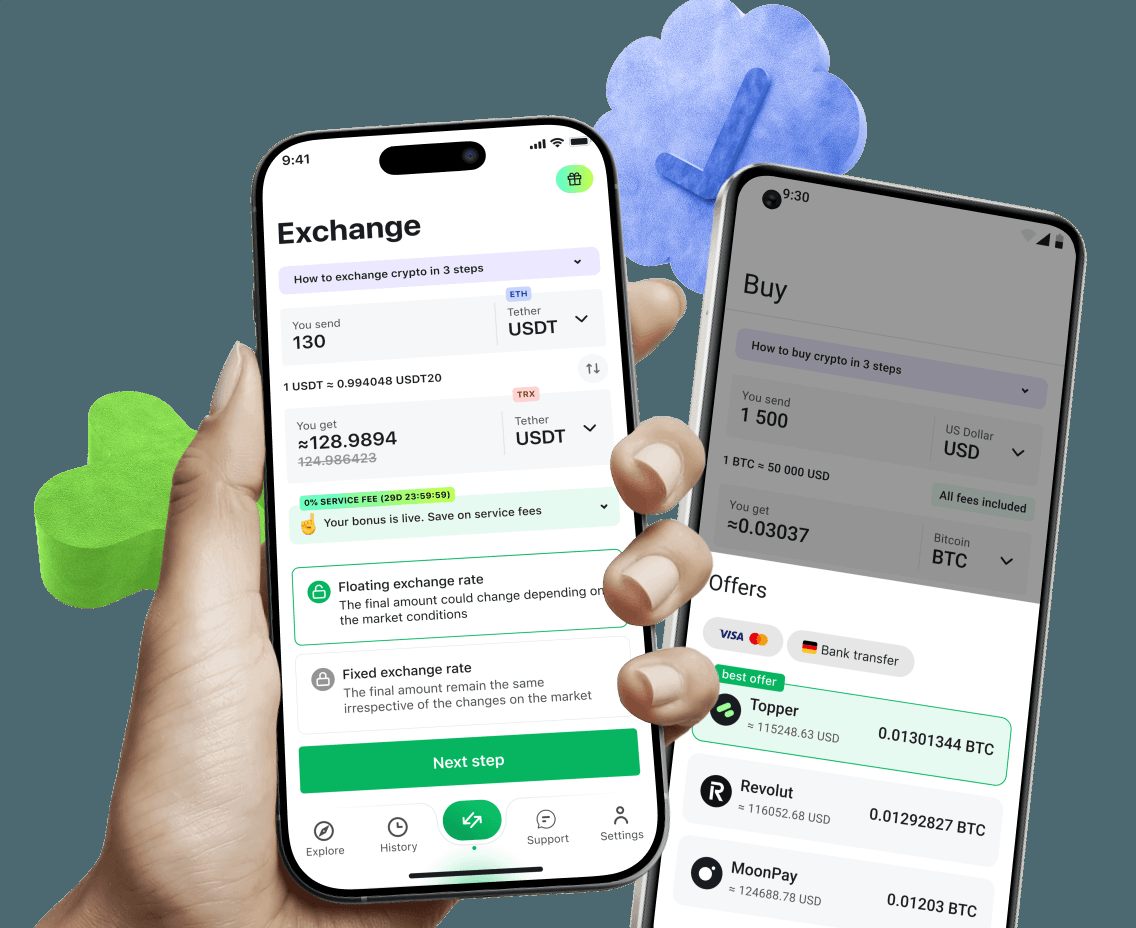
A typical order starts with a pair: for example, BTC to ETH, USDT to SOL, or ADA to XRP. The user chooses the asset being sent, the asset being received, the amount, and the receiving wallet address. Changelly exchange then shows the rate type, estimated payout, network requirements, and deposit address for the transaction.
After the deposit reaches the required network confirmation level, the service completes the conversion through its liquidity partners and broadcasts the outgoing transfer. This flow matters because the user controls the destination wallet from the start. The exchange step is temporary; the final asset leaves for the address entered during the order rather than staying in an exchange account balance.
Fixed and floating rates change the tradeoff
Rate choice is one of the main decisions before sending funds. A floating rate follows the live market during the order window, so the final amount reflects market movement and execution conditions. A fixed rate locks the quoted payout for a limited time, which gives more certainty when prices move quickly.
Fixed pricing suits users who care about receiving a defined amount of ETH, BTC, XRP, or another asset. Floating pricing suits users who accept a live market result in exchange for a quote that tracks current liquidity. Either way, the network fee and the partner route affect the final economics, especially during busy periods on Bitcoin, Ethereum, or other high-demand chains.
Where the 1000+ asset list matters
The broad coin list is the clearest reason people use Changelly exchange instead of only relying on a single centralized marketplace. It covers major assets, stablecoins, and many long-tail altcoins that are harder to pair directly on simpler wallet apps. The official asset set also includes wrapped or chain-specific versions of tokens, which makes chain selection more than a minor detail.
USDT is the easiest example. Tether exists on multiple networks, including Ethereum as an ERC-20 token and Tron as a TRC-20 token, and exchange support differs by network. Sending a token on the wrong chain creates a serious recovery problem, so the asset ticker, network label, deposit address format, and wallet support need to match before the transaction leaves the sender's wallet.
Buying crypto with cards and other fiat routes
The service also presents fiat-to-crypto buying options through payment providers. A card purchase is a different workflow from a crypto-to-crypto swap: the user chooses a fiat amount, selects a coin such as Bitcoin or Ethereum, reviews available offers, and completes payment through the selected provider. Identity checks and payment availability are tied to the provider, the user's location, and the payment method.
This marketplace-style structure gives a single screen for comparing routes, while the actual card processing sits with the provider handling the purchase. It is useful for first purchases, adding funds to a self-custody wallet, or buying a token that will later be swapped into another asset. Bank card convenience carries visible costs, so the quoted received amount deserves more attention than the payment button.
The app, support, and everyday usability
Changelly exchange appears in web and mobile workflows, with an app promoted in multiple languages and customer support positioned as a round-the-clock channel. That support layer matters because instant swaps still depend on block confirmations, memo fields, chain selection, and liquidity availability. A simple interface reduces the trading burden, yet the underlying transfer remains an on-chain payment.
New users get the cleanest experience by starting with a familiar network and a modest amount. The order screen should show the pair, rate type, receiving address, deposit address, expected amount, and any destination tag or memo before funds move. Wallets such as Trezor, Ledger, Exodus, and other self-custody tools also expose exchange routes, and those integrations route users into third-party services rather than changing how blockchains settle transfers.
Fees, network costs, and final received amounts
Pricing combines several pieces: the displayed exchange rate, the service spread or fee, the liquidity partner's execution, and blockchain network fees. Changelly exchange focuses the user on the estimated received amount, which is the number that matters most for a completed swap. For small trades, network fees consume a larger share of the value, especially on chains where blockspace is expensive.
A quick pre-swap review should cover the following points:
- The exact asset and network being sent
- The receiving wallet address and any memo or destination tag
- The fixed or floating rate selection
- The estimated amount after exchange and network costs
- The minimum and maximum amount allowed for the pair
Those details are practical rather than ceremonial. A wrong memo on XRP-style transfers, a mismatched USDT network, or a deposit below the minimum breaks the smooth instant-swap experience and moves the problem into support and recovery.
When a centralized exchange or DEX is a better fit
Instant swaps are strongest when speed and wallet delivery matter more than order-book control. A centralized exchange such as Coinbase, Kraken, or Binance offers account balances, advanced order types, tax reports, and deeper fiat rails. A decentralized exchange such as Uniswap gives direct smart-contract trading for supported tokens and networks, especially inside Ethereum-compatible wallets.
In practice, Changelly exchange occupies a different lane: pick a pair, enter a wallet, send funds, and receive the output asset. It suits one-off conversions, wallet-funded trades, and access to many altcoins without studying a full trading interface. Active traders who need limit orders, charting, API execution, or precise slippage settings get better control from a dedicated exchange venue.
Security habits for an instant exchange order
The strongest habit is address discipline. Copy the destination address from the receiving wallet, check the first and last characters, confirm the chain, and keep the order page open until the deposit transaction is visible. For assets such as XRP, XLM, ATOM, and some exchange-account deposits, the memo or tag is part of the routing data and belongs in the order exactly as requested.
Because Changelly exchange sends the received crypto to a wallet address, the sender's wallet setup determines long-term custody after the swap. Hardware wallets add transaction confirmation on a separate device, while mobile wallets make smaller trades faster. The exchange service handles conversion; the user's wallet choice determines storage, backup, and day-to-day access after settlement.
Who gets the most value from it
The best fit is a user who already has crypto in a wallet and wants a straightforward conversion into another asset. Someone holding BTC who wants ETH, a stablecoin holder moving into SOL, or a wallet user collecting a smaller token benefits from a pair-based interface and a large asset catalog. Changelly exchange also serves users who prefer receiving coins directly into self-custody after the order closes.
It is less compelling for high-frequency trading, very large orders that need advanced execution tools, or strategies built around DeFi liquidity pools. For those cases, order books, aggregators, and DEX routers provide controls that an instant exchange screen intentionally hides. For ordinary wallet-to-wallet conversion, the service's value is the combination of asset coverage, quick settlement, and a transaction path that ends in the user's chosen wallet.
Changelly exchange: questions and answers
How long does a Changelly exchange swap take?
A completed swap is commonly framed around 5 to 40 minutes, but the real timing follows blockchain confirmations, liquidity routing, and the selected asset pair. Bitcoin deposits take different confirmation time than faster networks, and congested chains slow settlement. Once the incoming transaction is confirmed and the route executes, the purchased asset is sent to the wallet address entered in the order.
Do I need an account to swap crypto through Changelly exchange?
Crypto-to-crypto swaps are built around a wallet-to-wallet order flow, so the main requirements are the asset being sent, a supported pair, and a valid receiving address. Some orders trigger additional checks, and fiat purchases through card or payment providers involve provider-side requirements. The exact requirement depends on the payment route, region, asset, and risk review tied to the transaction.
What happens if I send the wrong network token?
A token sent on the wrong network can fail to credit correctly because the deposit address and chain must match the order. USDT, for example, exists on several networks, and support for one version does not mean support for every version. If the transaction has already broadcast, recovery depends on the asset, chain, and deposit infrastructure, and it is not a normal instant-swap flow.
Which wallets work well with Changelly exchange swaps?
Any wallet that supports the asset and network involved in the order can receive the payout, including hardware wallets, mobile wallets, and desktop wallets. The important part is compatibility with the exact coin and chain, not just the ticker symbol. Wallets such as Ledger, Trezor, Exodus, and MetaMask are common self-custody options, but each supports a different set of networks and tokens.
Is a fixed rate better than a floating rate?
A fixed rate is better when the user wants a defined received amount and wants protection from price movement during the order window. A floating rate follows live market execution, so the final payout moves with liquidity and market changes. The better choice depends on whether certainty or market-tracking pricing matters more for that specific swap.
Fees on Changelly exchange: what affects the final amount?
The final amount reflects the exchange rate, service pricing, liquidity partner execution, and blockchain network fees. Small swaps feel network fees more sharply because a flat chain cost takes a larger share of the trade. The quote screen's estimated received amount is the clearest number to compare, especially when choosing between fixed and floating rates or between different assets.
Can United States users use Changelly exchange?
Availability for United States users depends on the product path, state, asset, payment method, and provider involved in the order. Crypto swaps and fiat purchases do not follow the same requirements, because card purchases route through payment providers with their own eligibility rules. A user in the United States should expect availability and identity checks to vary by transaction type and location.